Flowtrace
Runs AI agent workflows as a series of auditable steps, saving each output to a version-controlled repository for verification, debugging, and reuse.
The gist
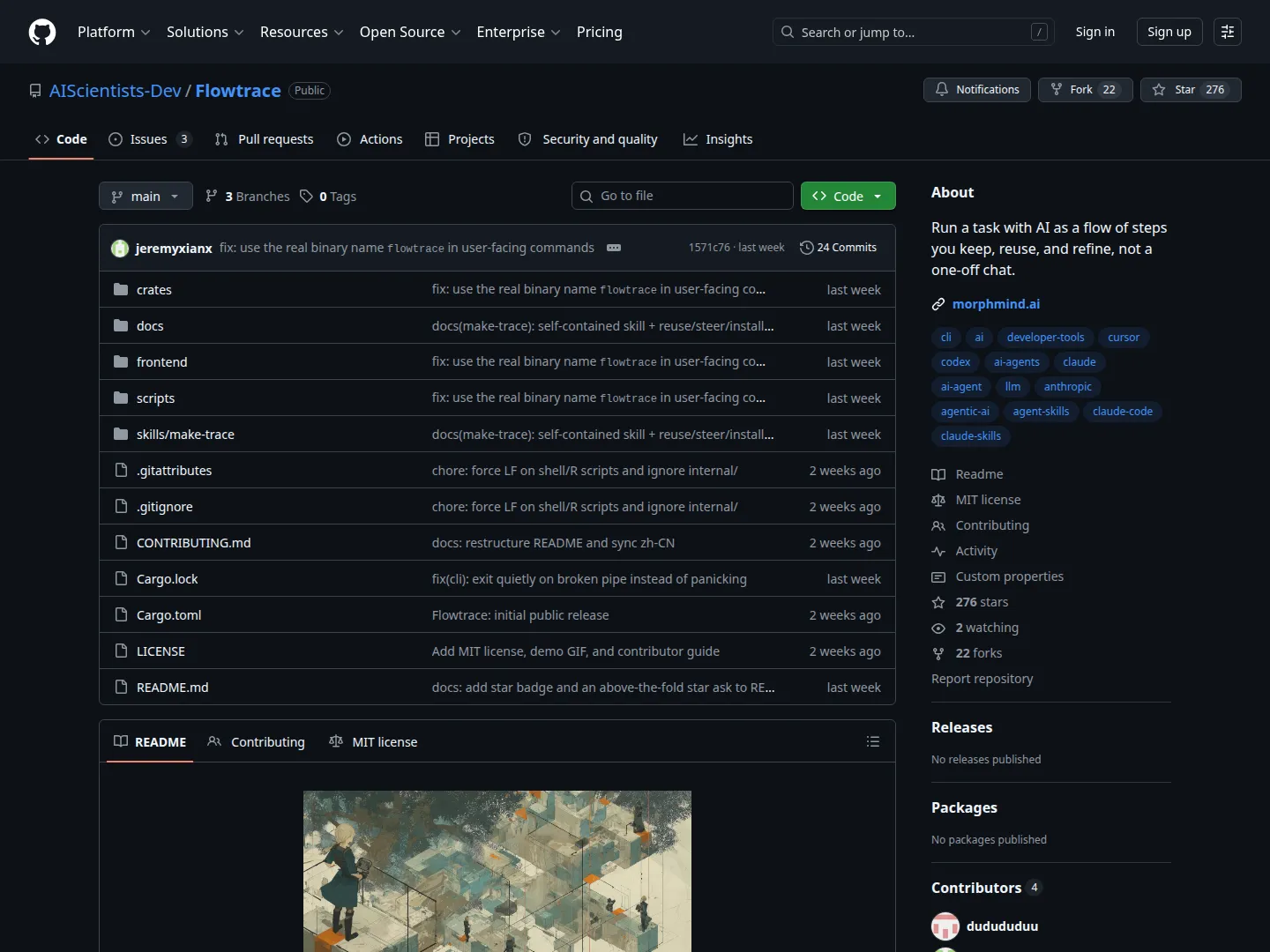
Flowtrace is an open-source tool by AIScientists-Dev for structuring AI agent workflows. It addresses the problem of chaotic, hard-to-follow text streams generated by agents like Claude Code or Codex. Instead of a single chat log, Flowtrace runs agent tasks as a sequence of discrete, inspectable steps, with each step's output saved to disk. This makes complex agent work verifiable, reusable, and easier to debug when a step goes wrong.
What it does
- Run AI agent workflows as a sequence of discrete, verifiable steps.
- Save the output of each step to disk for easy inspection and reuse.
- Visualize the entire workflow and its dependencies in a local web interface.
- Rerun only the dependent steps after fixing or changing a single step.
- Store the entire run history in a Git repository for a complete audit trail.
How it works

Flowtrace is an open-source CLI tool that orchestrates AI agent tasks. A user defines a workflow in a trace.json file, which specifies the steps and their dependencies. The tool executes each step sequentially, writing all outputs to the file system within a Git repository. This creates a complete, version-controlled audit trail of the agent's work. A local web server can be launched to visualize the entire workflow graph and its progress.
Best for
Flowtrace is best for developers and researchers using AI agents for complex, high-stakes tasks that require verification and auditing. It's ideal for workflows like financial analysis or security reviews, where every step of the agent's reasoning must be traceable and repeatable.
Watch out for
As the project documentation notes, Flowtrace is overkill for simple, one-off questions to an AI agent. It is designed for complex, repeatable workflows where verification is critical.